Mastering the Crochet Abbreviation Dictionary: Your Ultimate Guide
Decode US and UK crochet abbreviations effortlessly with our comprehensive crochet abbreviation dictionary.
WeLovePattern Editorial Team
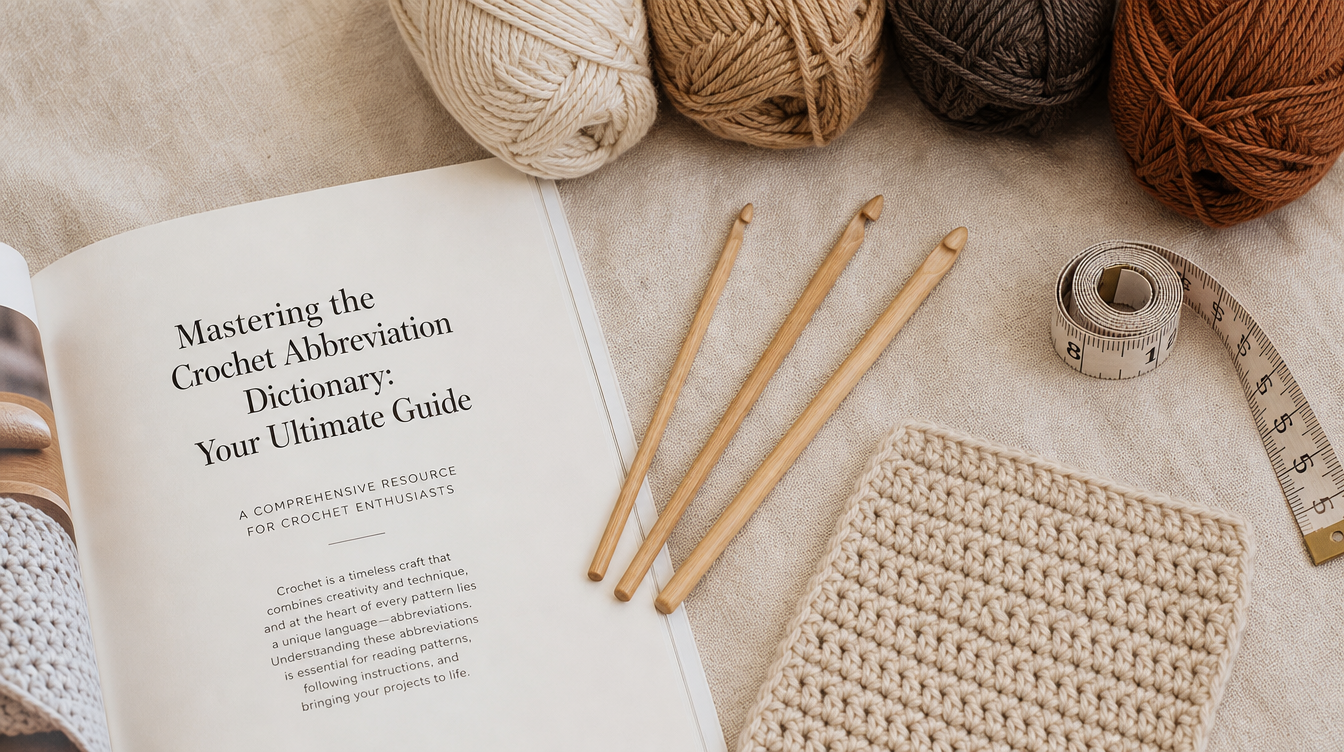
Understanding the Need for a Crochet Abbreviation Dictionary
As a crochet enthusiast, you've likely encountered patterns filled with abbreviations that resemble a new language. These abbreviations, while initially perplexing, are essential for maintaining the concise nature of crochet instructions. However, the challenge arises when these abbreviations differ between US and UK patterns, leading to potential confusion. Our crochet abbreviation dictionary is your go-to resource for decoding these terms, making your crafting journey smoother and more enjoyable.
The Basics of Crochet Abbreviations
Before diving into complex patterns, it's vital to familiarize yourself with standard crochet abbreviations. In the US, a 'sc' stands for single crochet, while in the UK, it equates to a 'dc' or double crochet. These differences can significantly impact your project if not identified correctly. The WeLovePattern Crochet Abbreviation Dictionary provides a comprehensive glossary that includes these terms and many others, complete with stitch diagrams and descriptions.
Common US Crochet Abbreviations
- sc: Single Crochet
- dc: Double Crochet
- hdc: Half Double Crochet
- tr: Treble Crochet
Common UK Crochet Abbreviations
- dc: Double Crochet (US Single Crochet)
- tr: Treble Crochet (US Double Crochet)
- htr: Half Treble Crochet (US Half Double Crochet)
- dtr: Double Treble Crochet (US Treble Crochet)
How to Use the Crochet Abbreviation Dictionary
Our interactive tool is designed to simplify your crochet experience. To use the dictionary, search for the abbreviation in question. The tool provides both US and UK equivalents, along with visual stitch diagrams and step-by-step descriptions to ensure clarity. This feature is especially helpful when transitioning between patterns originating from different regions.
Practical Application: Working with Patterns
Imagine you're working on a baby blanket, which typically measures 30 x 36 inches (76 x 91 cm) and requires 700 to 1,000 meters of yarn. You've selected a pattern that uses both US and UK terms. With our crochet abbreviation dictionary, you can quickly identify each term, ensuring that your blanket turns out as intended. The dictionary helps you avoid misinterpretation, which could lead to incorrect stitch counts and potentially running out of yarn.
Example Scenario
- Identify the abbreviation in your pattern, e.g., 'sc' or 'dc'.
- Use the dictionary to determine the correct stitch in your region's terminology.
- Follow the provided stitch diagram and instructions to execute the stitch correctly.
- Continue with confidence, knowing that your pattern interpretation is accurate.
Understanding Yarn and Hook Selection
Choosing the right yarn and hook is crucial for achieving the desired outcome in a crochet project. For the approved yarn weights, such as CYC #4 Worsted and CYC #3 DK, it’s important to select the suitable hook sizes, 5.0 mm (H-8) or 4.0 mm (G-6), respectively. The type of yarn, whether wool, acrylic, or cotton, affects the texture and elasticity of your finished piece. Wool is warm and elastic, making it ideal for garments, while acrylic offers versatility and ease of care. Cotton, known for its strength and absorbency, is perfect for items like dishcloths or summer wear.
Calculating Yarn Needs Accurately
Accurate yardage calculation is essential to avoid yarn shortages. The Area Ratio Swatch Scaling Method is a reliable technique for estimating the amount of yarn needed. This method involves creating a swatch, measuring its area, and comparing it to the project’s total area. By multiplying the result by the swatch yardage and adding a 10% safety buffer, you ensure that variations in tension and pattern adjustments are accounted for.
Techniques to Improve Your Crochet
Blocking is a critical process that can enhance the appearance of your crochet projects. Wet blocking involves soaking the item in water, shaping it to the desired dimensions, and allowing it to dry. Steam blocking, alternatively, uses steam to relax the fibers, making it ideal for delicate materials. Additionally, maintaining even tension while crocheting prevents issues like uneven stitches or border curling. If you encounter these problems, adjusting your grip on the yarn and practicing consistent stitch size can be beneficial.
Crochet Abbreviation Dictionary
Comprehensive US vs UK crochet stitch glossary with stitch diagrams and step-by-step descriptions.
Frequently Asked Questions
What is the difference between US and UK crochet terms?
US and UK crochet terminology differ mainly in stitch names; for example, US 'single crochet' is UK 'double crochet'.
Why is a safety buffer important in crochet projects?
A safety buffer accounts for variations in tension, pattern adjustments, and ensures sufficient yarn supply.
How do I calculate the amount of yarn needed for a project?
Use the Area Ratio Swatch Scaling Method to estimate total yardage based on a sample swatch and project dimensions.
Embrace the Power of Accurate Crochet Interpretation
By mastering the crochet abbreviation dictionary, you unlock the ability to tackle any pattern with confidence, regardless of its origin. This tool not only enhances your understanding but also ensures that your projects are executed with precision and creativity. Begin your journey today with the WeLovePattern Crochet Abbreviation Dictionary and transform your crochet experience.