Mastering Yarn Weight Conversion for Crochet Projects
Learn to convert yarn weights effortlessly with our guide and tool, ensuring your crochet projects are perfectly sized and gauged.
WeLovePattern Editorial Team
Understanding Yarn Weight Conversion in Crochet
Yarn weight conversion is an essential skill for crocheters who want to substitute yarns or replicate a pattern in different yarn weights. This process involves understanding how different yarn thicknesses impact the outcome of your crochet projects, including hook size, yardage, and the final dimensions. By mastering yarn weight conversion, crocheters can ensure their projects maintain the intended aesthetics and functionality, even when using alternative yarns.
Why Convert Yarn Weights?
Converting yarn weights becomes necessary when you fall in love with a pattern but have a different yarn in your stash, or when a specific yarn is unavailable. Using the correct yarn weight ensures that the project’s size and drape match the designer's original vision. However, substituting yarn weights requires careful adjustment to maintain gauge and the intended look of your project. This involves recalculating yardage and possibly adjusting hook size to ensure the final piece retains its intended dimensions and texture.
Manual Yarn Weight Conversion
Step 1: Identify the Yarn Weight
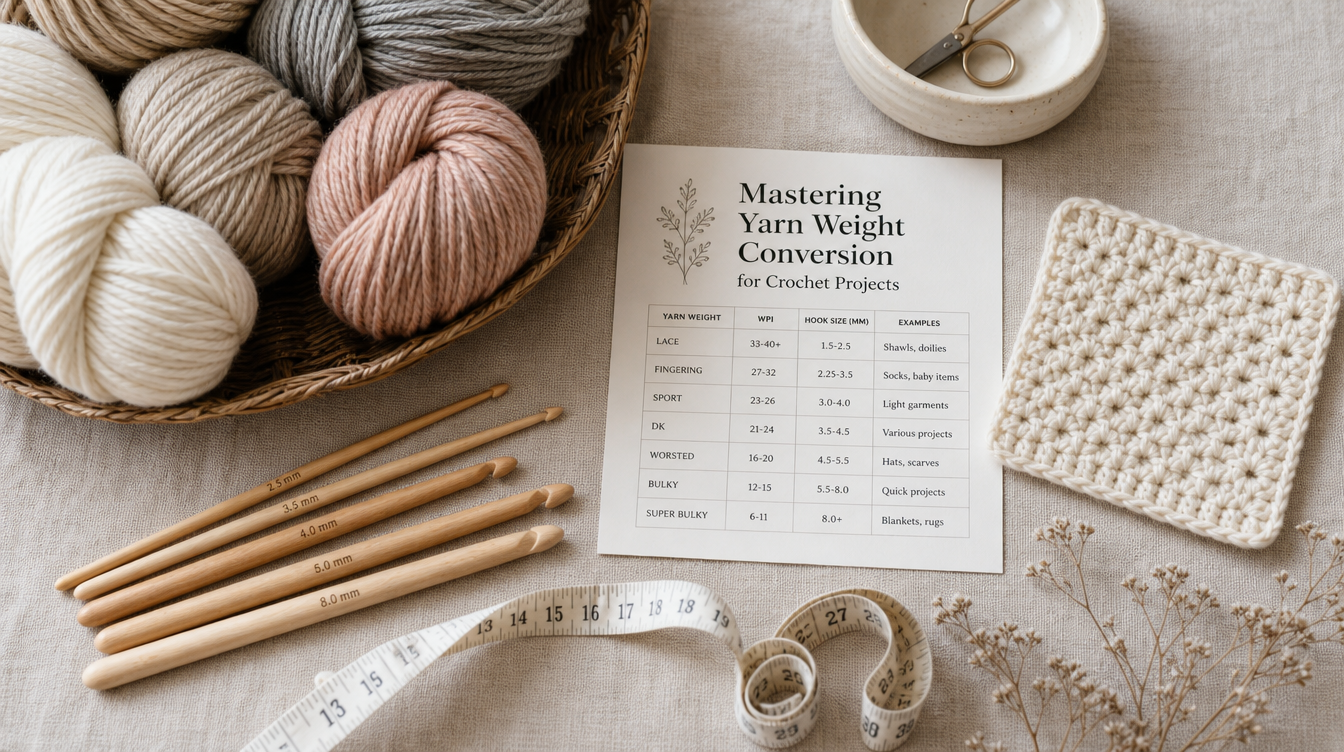
Begin by identifying the yarn weight of your existing yarn and the yarn specified in the pattern. The Craft Yarn Council (CYC) categorizes yarns from Lace (CYC #0) to Jumbo (CYC #7). For this guide, we'll focus on common weights: Worsted (CYC #4), DK (CYC #3), and Sport (CYC #2). Understanding these categories helps you match yarns across different brands and adjust your project specifications accordingly.
Step 2: Match Yarn Weights with Hook Sizes
Once you know the yarn weight, select the recommended hook size. For instance, a Worsted yarn pairs well with a 5.0 mm (H-8) hook, DK with a 4.0 mm (G-6), and Sport with a 3.5 mm (E-4). Adjusting the hook size appropriately helps maintain the pattern’s intended gauge. This ensures that the crochet fabric remains consistent and the structural integrity of the piece is preserved, avoiding issues like excessive stiffness or unwanted draping.
Step 3: Recalculate Yardage
Yarn weight affects the amount of yarn needed. Use the Area Ratio Swatch Scaling Method:
- Measure your swatch's dimensions and calculate its area.
- Calculate your intended blanket's area using standard dimensions (e.g., Throw Blanket: 50 x 60 inches).
- Record the yardage used in your swatch.
- Apply the formula: Total Yardage = (Blanket Area / Swatch Area) * Swatch Yardage * 1.10.
This method provides an accurate yardage estimate, accounting for texture stitches that consume more yarn. Be mindful that stitches like bobbles and puff stitches consume more yarn than flat stitches like single crochet and double crochet. Therefore, it's essential to consider these factors when estimating yarn usage.
Fiber Choices and Their Impact
The type of fiber also plays a significant role in yarn weight conversion. Wool, for example, is known for its elasticity and warmth, making it ideal for garments. Acrylic is versatile and easy to care for, while cotton offers excellent breathability and stitch definition. Each fiber type affects the drape, weight, and texture of the finished piece, so selecting the right fiber is crucial for achieving the desired outcome in your crochet project.
Blocking Procedures
Blocking is a vital step in finishing crochet projects, especially when substituting yarn weights. Wet blocking involves soaking your piece in water, gently reshaping it to the desired dimensions, and letting it dry. Steam blocking, on the other hand, uses steam to relax fibers and set the shape. Both methods help even out stitches and enhance the drape of the fabric, ensuring a polished final product.
Yarn Weight Converter
Standard 8-tier yarn chart (Lace to Jumbo) with WPI (Wraps Per Inch), recommended hooks, and substitutes.
Troubleshooting Common Issues
Uneven Tension and Border Curling
Uneven tension can result in an inconsistent fabric appearance. To combat this, practice creating consistent stitches and consider adjusting your hook size to better suit your tension style. Border curling is another common issue, often resolved by adding a border row or adjusting the initial tension. Blocking can also help relax the fabric and reduce curling.
Introducing the WeLovePattern Yarn Weight Converter
While manual calculations can help you understand the process, they can be tedious and prone to error. The WeLovePattern Yarn Weight Converter offers an interactive solution that simplifies this task. This tool allows you to input your current yarn weight and desired conversion, automatically providing the recommended hook size, equivalent yarn categories, and estimated yardage needs.
How to Use the Yarn Weight Converter
Using our converter is straightforward:
- Enter the current yarn weight and project size.
- Select the desired yarn weight for substitution.
- Receive a detailed output with recommended hook sizes, equivalent yarn options, and estimated yardage.
With this tool, you can confidently tackle any pattern using alternative yarns without worrying about complex calculations.
Practical Tips for Yarn Weight Conversion
- Always create a gauge swatch when substituting yarns to ensure your tension matches the pattern’s requirements.
- Be mindful that textured stitches, like bobbles, consume more yarn than flat stitches, and adjust your yardage estimate accordingly.
- Purchase 10% to 15% more yarn than calculated to accommodate variations in tension and potential errors.
Frequently Asked Questions
How do I convert yarn weights between brands?
Refer to the CYC standards to match yarn weights by category, and adjust hook size and gauge accordingly.
What happens if I use a different yarn weight than the pattern suggests?
Using a different yarn weight will affect the size and drape of your project. Recalculate the yardage and adjust your hook size to maintain gauge.
How much extra yarn should I buy to ensure I don't run out?
It's standard to purchase 10% to 15% more yarn than estimated to account for variations in tension and potential errors.
Understanding yarn weight conversion empowers you to make informed decisions in your crochet projects, ensuring each piece turns out exactly as imagined. Whether you're adjusting a beloved pattern or experimenting with new yarns, our Yarn Weight Converter tool is here to guide you every step of the way. Let's Convert Yarn Weights →